Showing posts with label modern china. Show all posts

Sunday, April 24, 2016

20160425 China Daily_Chengdu's Silicon Valley dream powers rise of startups

Chengdu's Silicon Valley dream powers rise of startups
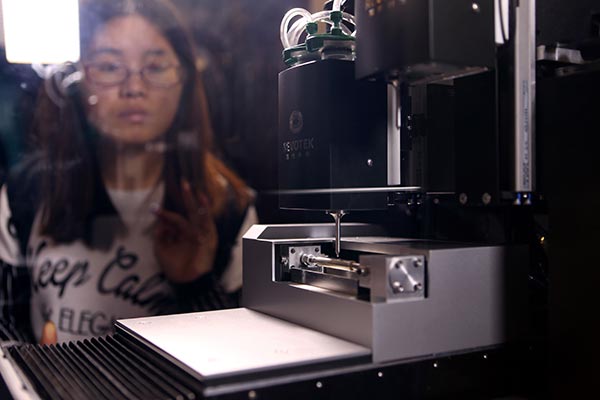
A woman looks at a 3D bioprinter, developed by Revotek, at the launch of the product last October.[Provided to China Daily]
Holed up in a shiny glass building in the Chinese city of Chengdu, Y. James Kang spends his days researching ways to repair damaged hearts, livers and brains-with the help of stem cells and 3D printers.
The Chinese-born and US-trained biologist set up his healthcare startup, Revotek, in this southwestern city in 2014. At the time, he was attracted by the region's rich local supply of monkeys that were ideal for testing human treatments. In Chengdu, the company has drawn 215 million yuan ($33 million) in funding from a local real estate company seeking to diversify.
A few miles from Kang's lab, AllTech Medical Systems has developed and is selling MRI systems intended to compete with multinational giants such as General Electric Co, Royal Philips NV and Siemens AG, which have dominated the market. Its MIT-trained founder, Zou Xueming, chose Chengdu to start his second company after selling his Cleveland-based startup to GE in 2002. AllTech hopes to submit an application to go public by the end of next year, with Zou planning to raise $50 million to $100 million.
They are among a string of local businesses that stand to benefit from a push by the Chinese city to attract researchers and venture capital investors. Known for its spicy cuisine and leisurely lifestyle, Chengdu has in recent years attracted the likes of Intel Corp and IBM, which have set up research and manufacturing bases there. More recently, the flurry of investment activity is in response to Chinese Premier Li Keqiang's call for innovation and entrepreneurship.
China's leaders are seeking new engines of growth as the country's economic expansion hits its slowest pace in 25 years. That's encouraged provinces across the country to create special zones where new ventures can tap funding opportunities and other incentives. While technology startups have been some of the biggest beneficiaries, medical research firms are also getting a boost-giving new life to a Chinese industry that lagged the West for years.
Since it was launched in 2014, China's campaign to encourage entrepreneurship has helped create tens of thousands of small companies. In Chengdu, the local government has set up seven start-up focused funds backed by private capital totaling 700 million yuan to promote industries like telecommunications, health and biotech.
The science and technology bureau has a dedicated team to help banks assess startups based on the value of their technology and patents. It also has incubators that provide office space and training to new businesses. "There are strong driving forces," in Chengdu, said AllTech founder Zou. "Policies to attract talent, land and tax policies are very favorable."
Like Kang's firm, most of Chengdu's startups are many years away from making big profits from their businesses. That means Chengdu's government also has a long wait before it sees major benefits to the local economy.
Dozens of Chinese cities are launching similar programs, and these new ventures also offer a window into the rising ambitions of Chinese researchers, many of whom have trained overseas. Kang was among the first batch of Chinese to go back to college in 1977 after the Cultural Revolution, eventually earning his PhD at Iowa State University. His primary research focus now is 3D bioprinting, a new frontier of medicine aimed at creating replicas of human organs.
His team has been developing techniques to repair damaged skin, hearts, livers and brains in animals including pigs and monkeys through regeneration-a process that involves creating 3D printed structures that can replicate, for example, a layer of skin or a blood vessel. For organs like a damaged heart, a specialized catheter is used to deliver "bio-ink" or stem cells mixed with nutrients and other growth factors.

Tuesday, March 17, 2015

20150318 China Daily_Shanghai prepares for clean air

Authorities say PM2.5 remains a big problem as it outlines 100 billion yuan action plan
Shanghai prepares for clean air
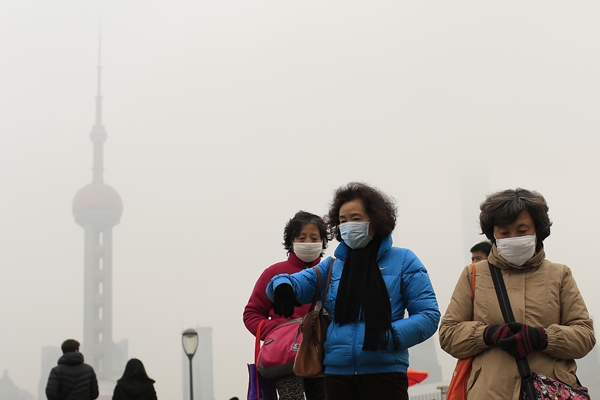
Woman wear face masks on the Bund in front of the Oriental Pearl TV Tower during a hazy day in downtown Shanghai January 26, 2015. [Photo/Agencies]
Shanghai plans to invest 100 billion yuan ($16 billion) in its environmental protection drive for the coming three years, while reducing the concentration of PM2.5 by at least 20 percent from the level in 2013.
Those are part of the targets the municipal government outlined in an action plan for the period between 2015 and 2017.
One of the highlights of the plan, released on Tuesday, is the increase of capital invested to improve the environment from the average of 21.3 billion yuan in the past 15 years to an average of 33.3 billion yuan committed for the upcoming three years.
Improvements in air quality, water and the ecology will be the focus of the plan.
Measures to fight smog, for example, include shifting the coal-burning boilers and industrial furnaces to clean fuels, transforming power generators to reduce their emissions, phasing out high-polluting vehicles and putting in place further control on dust at construction sites.
Those efforts are expected to help reduce emissions of sulfur dioxide by 20,000 metric tons nitrogen oxide by 40,000 tons and volatile organic compounds by 100,000 tons.
Yang Xin, a professor at Fudan University's department of environmental science and engineering, called the action plan practical, saying that the government is moving in the right direction to address the biggest concerns of the public regarding the environment.
"In 2014, we saw a big drop in the concentration level of PM2.5 from the previous year," he said. "That makes the goal of a 20 percent reduction by 2017 not that difficult."
Shanghai prepares for clean air
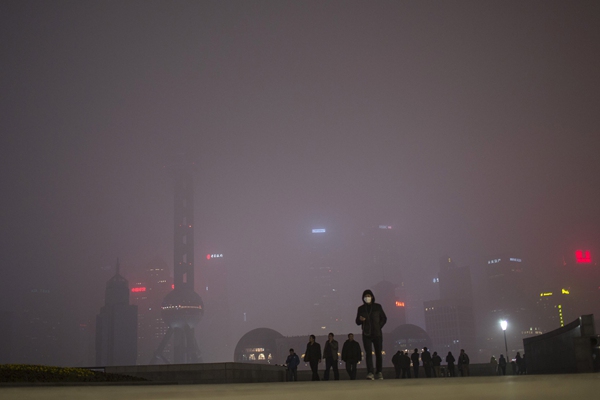
A man wears a face mask while walking on the Bund in front of the financial district of Pudong, during a hazy day in downtown Shanghai January 25, 2015. [Photo/Agencies]
But the government needs to do more to make the public clearly see the improvement in the environment, he said.
"Lowering PM2.5 levels by 20 percent means a huge reduction of its harm on people's health. But it won't bring along great improvement in the visibility of the air, and visibility actually is the main benchmark for the public to judge air quality," he added.
Public perception
Most Shanghai residents questioned on Tuesday said air pollution worsened in 2014, though monitoring data suggested there was an improvement of air quality compared with 2013.
"I didn't feel an improvement at all. We often saw a gray sky caused by the smog," said 24-year-old Yu Canglong.
In the action plan, authorities admitted that PM2.5 and air pollution remain prominent problems, despite the overall improving environment in the city.
For the upcoming three years, the government also vowed to reduce the number of highly polluted water bodies, raise forestation coverage from 13.5 percent to 15.5 percent, and build a sewage disposal system for 90 percent of waste water in urban areas.
On the national level, the country is set to focus efforts this year on fully implementing the revised Environmental Protection Law, which took effect on Jan 1.
No one must use his power to meddle with law enforcement, Premier Li Keqiang said on Sunday at a news conference following the closing of the annual session of the nation's top legislature.
"All acts of illegal production and emissions will be brought to account. We will make the cost for doing so too high to bear," he said.

Tuesday, December 2, 2014

20141203 China Daily_Digital daze

Digital daze
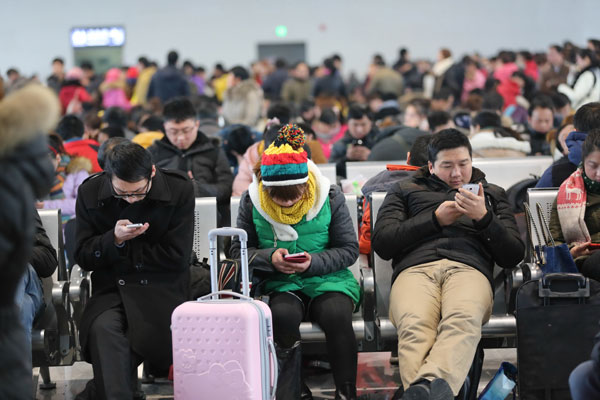
More Chinese read through their smartphones.
With the use of smartphones and tablets rising in the country, many Chinese are taking to e-reading. Xing Yi reports. With the rise in popularity of smartphones and tablets, Chinese are reading more on their palms.
A recent report by Esurfing Reading Culture Communications, a China Telecom subsidiary,points to the trend. The company provides ereading and other digital content to about 220
million registered users in the country.
According to the report, released on Nov 26, about 40 percent of the company's users of its esurfing reader app read between 6 am and 9 am, overlapping with the commuting time 
most people use to get to work.
The company's users in second- and third tier cities read more digital books as compared toBeijing or Shanghai, which aren't on the 
top ereading list, according to the report. Taizhou, a coastal city in eastern China's Zhejiang province, with around 6 million people, topped the chart with an annual average readership 
of 10.5 e-books in 2014. The national average was 2.48 titles in 2013.
The report throws up interesting reading habits across different provinces, regions and cities.
For example, readers in Beijing prefer spooky thrillers such as Gui Chui Deng (Candle in theTomb) and Dao Mu Ren (Tomb Robber); readers in Shanghai like humorous short stories 
and collections of jokes after a hard day's work; people in Suzhou, one of China's top 
tourist spots, like romantic novels set in imperial times while residents of Chongqing devour fantasy martial arts books.
Since the report by E-surfing is limited to its own users of the e-surfing reader app, a national survey released by Chinese Academy of Press and 
Publication earlier this year may provide a clearer picture.
According to that survey, conducted on 40,600 people across 74 cities in 29 provinces,
regions and municipalities, more than half of the readers polled had some digital reading
experiences in 2013.
Some five years ago, readers with such experiences made up just 24 percent of the 25,500people surveyed.
According to the academy, 66 percent of the people responding earlier this year preferred reading paper books. While 15 percent of people read online on computers, there were 15.6 percent that used mobile phones for reading. The users of e-reading devices such as Kindle were only 2.4 percent.
Most of the people who prefer digital reading are aged from 18 to 49, representing 92.6 
percent of those who tried to read e-books. The survey said that children under 17 remain
largely readers of paper books due to their parents' concern over their eyesight.
The rapid development of digital reading poses challenges for both digital and traditional 
publishers as the survey finds that more than 90 percent of readers claim they won't buy 
paper books after they have read the same title online while only around 40 percent of the mare willing to pay for the content, and the rest only read free content.
According to the annual report of China's publishing industry from 2013 to 2014, the 
operating revenue for digital publishing in China touched 250 billion yuan (around $40 billion), with a profit of nearly 20 billion yuan by 2013.
As the second-largest book market after the United States, China's total output in publishing,printing and 
distribution exceeded 1.82 trillion yuan in 2013, up 9.7 percent from the previous year.
But while digital publishing has grown rapidly, the growth of the traditional publishing sector 
in China has been slowing down in the past few years. In 2013, digital publishing grew at 
31.3 percent as compared to 2012, earning 19.9 billion yuan.
But experts don't think traditional publishing will fade away soon.
"Even for traditional publishing, though its market share will shrink, I don't think it will die out,and for the time being, it will still remain stable," Xiao Dongfa, the director of Modern Publishing Institute at Peking University, tells China Daily.
He adds that overall publishing will remain a "sunrise industry", because Chinese like to 
read.
"Be it digital or traditional, the needs for education, entertainment and obtaining information all point to publishing."
Sun Lijun, a professor of publishing at Renmin University of China, agrees with the optimismof Xiao, and points out that the burgeoning digital publishing in China has given the country an advantage to compete with mature Western markets. "The stable economic growth is good news for the publishing industry."

20141202 BBC_China media: Climate change talks 'onus on US'

A Chinese man squats on a truck near a power plant emitting plumes of smoke from industrial chimneys on 30 October 2007 in Beijing, China.

China and the US are both among the world's top polluters
As a key UN climate change conference opens in Peru, Chinese state media contrast their country's approach to what they cast as the United States' reluctance to shoulder its share of the burden of emissions cuts.
The week-long meeting of 195 countries in Lima - aimed at preparing for a new global climate pact in 2015 - comes after China and the US, two of the world's top polluters, pledged last month to cut greenhouse gas emissions.
The official news agency Xinhua says China is keen to reach a deal on carbon emissions, but adds in another article that progress is likely to be stymied by differences between the developed and developing world - with the US the main culprit.
"Some developed countries demand that developing countries, especially emerging economies, pledge emission cuts, but they are not interested in providing funds and technical assistance to these countries," the article says.
It adds that the US is the "hardcore representative of developed countries that are shirking responsibilities", and will "pressure other nations but avoid delivering its own promises".
State-owned Guangming Daily strikes a similar note, criticising the US and Europe for "not doing enough" while highlighting China's willingness to work towards a deal in accordance with "principle of fairness".
A report in the People's Daily enumerates the way Chinese enterprises and investments have been helping to combat climate change abroad, praising them for "actively protecting the environment of the countries they are in".
Speak softly
"Neighbourhood diplomacy" is the big buzzword in the Chinese papers following a speech by President Xi Jinping over the weekend in which he promised to improve ties with China's neighbours.
Mr Xi's remarks at a conference in Beijing on Saturday are seeing as having struck a conciliatory tone in relations with other countries in the region, which are frequently strained by longstanding disputes over territory.
An article in the Communist Party publication Qiu Shi lends its full support to Mr Xi's "big-country diplomacy", based on principles such as respect of countries' sovereignty and non-interference in their internal affairs.
Highlighting China's traditional insistence that its rise will be a peaceful one, the article also suggests Beijing focus on projecting soft power through culture and technology exports - as well as "the charm and the confidence of Chinese diplomacy".
Continuing the conciliatory theme, an article in the China Daily urges China not be suspicious of other countries' intentions in order to build "strategic partnerships".
According to the commentary, Beijing should understand that the US does not want the Chinese government or nation to collapse, and neighbouring countries do not want to contain it.
"China has a good record of solving disputes peacefully, and its diplomacy should show neighbours its sincerity and reflect its goodwill," it concludes.
'Overly cautious'
And finally, state media back the use of force to end the pro-democracy street protests in Hong Kong, while playing down suggestions that Beijing could deploy troops to the territory.
Hong Kong Chief Executive CY Leung has warned pro-democracy activists not to return to the streets following the worst clashes between protesters and police since the demonstrations began two months ago.
Condemning the protesters for "severely challenging" Hong Kong's rule of law, the Global Times chides the territory's police for being "overly cautious".
"We stand by the Hong Kong police, which can use force to halt the ruinous and subversive course of street politics", the paper says.
On the other hand, it also warns the mainland authorities against the "temptation" to quell the unrest with troops.
This, it argues, "can only bring temporary peace, but the deep-rooted causes will remain".

Monday, October 20, 2014

20141020 BBC_Beijing marathon runners don masks to cope with smog

Half marathon runner Chas Pope describes conditions in Beijing

Related Stories

Thousands of runners have taken part in the 34th Beijing International Marathon, many wearing face masks amid concerns about pollution.
The organisers warned runners to expect slight or moderate smog, but the US embassy in Beijing said air quality early on Sunday was "hazardous".
One resident in the city told the BBC that the air smelt like burnt coal.
Estimates said that pollution soared above the maximum recommended World Health Organization levels.
Runner in Beijing marathon (19 October 2014)China has for years been hit by severe air pollution
Runner Chas Pope's mask before and after the marathon (19 October 2014)Runner Chas Pope has posted pictures on the internet of his mask before and after the marathon
The WHO says daily pollution levels should not exceed an average of 25 micrograms per cubic metre of fine particulate matter.
Yet the US embassy's monitor at one point reported peaks of up to 400 micrograms per cubic metre, which it said would be hazardous if a human was exposed to it over a 24-hour period.
Fine particulate matter, the kind of pollution in smoke, damages the body as it moves deep into the lungs and can even enter the bloodstream.
'Should have been cancelled'
Some athletes gave up the race because of the pollution.
British runner Chas Pope tweeted that he was only able to do 10km (6 miles) of the race in a mask before he was forced to pull out.
He said that race should have been cancelled because the air quality was "not suitable for outdoor activities".
Ethiopia"s Girmay Birhanu Gebru wins the 34th Beijing International Marathon Ethiopia's Girmay Birhanu Gebru won the marathon in just over two hours and 10 minutes
Runners take part in the 34th Beijing International Marathon which began at Tiananmen Square (19th October 2014)Organisers rejected calls to postpone the race despite the haze
Runner in Beijing marathon (19 October 2014)Most runners defied the smog to enjoy the race
China's Gong Lihua, who came third in the women's race, said the smog had caused some difficulties.
"Running in this kind of smog, I felt I couldn't sweat well and my body has been very sticky and moist," she said.
Beijing resident Neil Holt told the BBC that although the air quality was better than last year, "it was still very polluted".
"You can hardly see [the stadium] through the smog. It's really hard to breathe when it is like this," he said.
The men's race was won by Ethiopian runner Girmay Birhanu Gebru and another Ethiopian, Fatuma Sado Dergo, won the women's race.

Tuesday, October 14, 2014

20141014 BBC_Universal to open theme park in China

Marvel comics hero Spiderman poses for the press at the Universal Studios in JapanUniversal Studios is set to open its first theme park in China

Related Stories

Universal Studios will open its first $3.3bn (£2bn) Chinese theme park after 13 years of trying to enter the booming entertainment market.
Hollywood director Steven Spielberg will help design the Beijing Universal park, the company said on Monday.
The park is being developed with local state firm Beijing Tourism Group.
Universal is the latest US firm to enter China's fast-growing entertainment sector after rivals Walt Disney and DreamWorks Animation.
The company did not say when the theme park would open, but reports say it will be in 2019.
Both Disney's $4.4bn theme park and DreamWorks' $3.1bn entertainment complex with Chinese partners are expected to open in 2016 in Shanghai.
Film studios are in a big rush to build theme parks in the world's second-largest economy as a rapidly-growing middle class is spending more money on entertainment and travel.
In April, Disney said it was increasing investment in its Shanghai Disney theme park by another $800m after striking a deal with a Chinese joint venture partner.
Growth in China's entertainment and media market is expected to more than double from 2013 to $148bn by 2015, according to a PricewaterhouseCoopers global study.