Thursday, December 3, 2015

20151204_China Daily_Beijing-Tianjin-Hebei govts to cooperate on emissions control

Beijing-Tianjin-Hebei govts to cooperate on emissions control
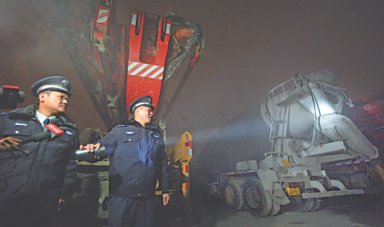
Environmental officials ensure production is suspended at a concrete mixing plant in Tongzhou district in Beijing on Monday as the city suffered from severe pollution. LIU CHANG/CHINA DAILY
The heavily polluted cluster of Beijing, Tianjin and Hebei province signed a cooperation framework on Thursday to control air, water and soil pollution, marking a breakthrough in regional integration, according to a statement released by the Beijing Municipal Environmental Protection Bureau.
The move set up a new joint coordination system to curb serious smog, and included a plan to create the first unified regulation on the control and prevention of environmental pollution in the region as a whole-including plans for the management of industries likely to affect air, water, soil and solid waste, said Li Lixin, head of the bureau's regional cooperation department.
In addition, the trilateral region will develop standards for emissions. Beijing currently has stricter standards than Hebei and Tianjin for emissions in major polluting industries and for vehicle exhaust.
The three will also conduct joint monitoring and inspections and share information on an environmental monitoring network, Li said.
Beijing, Tianjin and Hebei province have faced severe air pollution since 2013. The recent spell of smog that settled in to the region last week underlined the governments' need to take action quickly.
Half of the air pollutants in Beijing come from neighboring cities, Liu Hongli, associate researcher at the Chinese Academy of Meteorological Sciences, said on Thursday. Without effective regional control, it's hard to control the smog, he said.
In recent days, the capital saw the concentration of PM2.5 go off the air index charts, exceeding 945 micrograms per cubic meter on Sunday. The national safety level for PM2.5-particulate matter with a diameter less than 2.5 microns that poses health hazards to humans-is 75 micrograms per cubic meter.
In December, the trilateral region is forecast to have another two spells of heavy haze because of windless weather, but not as hazardous as the recent one that lingered until Wednesday, the national weather authority said.
The first spell is expected on Tuesday and will likely last for three days before a new cold front will again bring wind to North China, Liu said.
He added that a second spell of smog might come between Dec 14 and 16, covering a vast region of northern China.
Xue Jianjun, senior engineer at the National Meteorological Center, said the two spells of smog will occur between intervals of wind, and the southern cities in the region may experience severe smog.
Polluters to pay for damage
China will start a compensation system for ecological damage in some pilot provinces by the end of this year, with a view toward expanding it to the whole country in 2018 if successful.
The State Council published the pilot plan, the first national regulation of its kind, on Thursday, saying the system will be tried and improved as needed.
Provincial governments can ask for compensation when natural resources within their jurisdictions have been damaged. Companies, organizations or individuals responsible for the pollution will bear the burden of compensation.
Pollution caused by the mistakes of decision-makers in governments will be excluded.
Under the plan, compensation would cover the costs of environmental remediation and any economic losses arising from the cleanup process itself or any permanent losses.
Financial institutions such as banks will also be the targets of compensation if they give polluters loans knowing the risks of ecological damage.
The pilot plan also out-lines a process for governments to file lawsuits, make assessment reports and create rules to strengthen management after receiving compensation.

20151204_China Daily_China to become global nuclear energy player with 110 reactors

China to become global nuclear energy player with 110 reactors
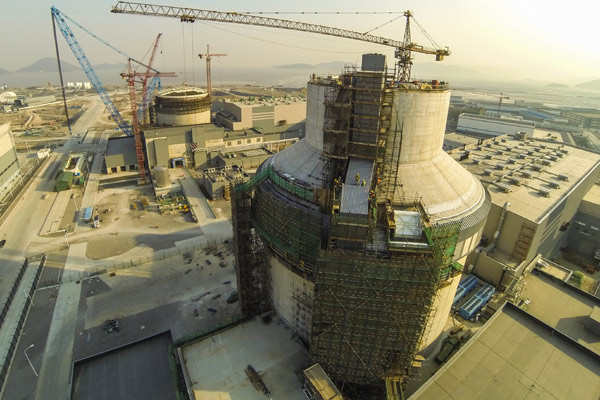
Nuclear reactors under construction in Sanmen, Zhejiang province.[Photo/Xinhua]
Exports of indigenous technologies to be key thrust in new five-year plan, saysPowerChina
China will have 110 operational nuclear reactors by 2030, making it one of the largest nuclearenergy users in the world by then, a leading power plant builder said on Thursday.
Power Construction Corp of China Ltd, also known as PowerChina, said that the total scale ofnuclear power generation from reactors both under construction and in operation in thecountry will reach 88 gigawatts by the end of 2020, according to estimates in the draft 13thFive-Year Plan (2016-20) for the power industry.
According to the draft plan, China will set aside 500 billion yuan ($78 billion) for setting upnuclear power plants using its homegrown nuclear technologies and add six to eight nuclearreactors every year from 2016 for the next five years.
Though it is only a draft proposal, it will "set the tone during the annual legislative and politicaladvisory sessions in 2016", the State-owned firm said.
During the first nine months of this year, the listed firm saw its revenue rise 24.7 percent to145 billion yuan from the same period a year earlier, according to a regulatory filing.
The Beijing-based company, founded in 2011, provides services including planning,investigation, design and construction to a wide range of sectors of the industry likehydropower, thermal power and nuclear.
It claims to have built about one-third of the nuclear reactors that are currently operating inChina.
The company's claims come at a time when China is embarking on a clean energy drive toreduce emissions, with nuclear being one of the major beneficiaries.
At the same time, China is also looking to popularize its homegrown pressurized-waternuclear technology known as Hualong One both at home and abroad.
In May, work on a pilot project involving Hualong One started in Fuqing, Fujian province,indicating that China is ready to export its nuclear technologies, experts said.
Sun Qin, chairman of China National Nuclear Corp, said the third-generation nucleartechnology meets the highest requirements for global safety standards and has a competitiveedge over others in terms of economic performance and reliability.
Chinese nuclear companies are already making huge inroads in global nuclear markets suchas the United Kingdom, Argentina and Kenya.
CNNC has clinched deals with Argentina to build two nuclear reactors-one using heavy-water technology developed by Canada's Candu Inc with an estimated cost of about $6 billionand the other possibly using the Hualong One technology.

There are 22 nuclear reactors in operation and 26 under construction in China, according tothe National Energy Administration.

Sunday, November 8, 2015

20151109 Standard_Choreographed historic meeting between Xi and Ma seen as symbolic message

Choreographed historic meeting between Xi and Ma seen as symbolic message
(11-06 19:51)

The maiden meeting between the presidents of China and Taiwan presents a formidable challenge: how can they ensure the event's place in history when nothing of substance should happen?
No agreements or joint statements are to be issued and only a vague agenda has been sketched out, a reflection of the extreme sensitivity surrounding the event, especially on the part of Taiwanese wary of Beijing's unification agenda.
Yet the event's symbolism as a moment of coming together is undeniable, putting a strong emphasis on presentation, atmosphere and optics.
The get-together is fundamentally “about recognition, not about results,'' said University of Virginia China expert Brantly Womack. “The meeting is the message.''
China's Xi Jinping and Taiwan's Ma Ying-jeou are the first leaders from the two sides to meet since their territories split during the Chinese civil war in 1949. Ma is the successor to Chiang Kai-shek, whose Nationalists retreated to the island, while Xi now leads Mao Zedong's victorious Communists, who set up government in Beijing.
Already, arranging the meeting has required extraordinary flexibility and patience.
According to Taiwan, planning for Saturday's meetings began two years ago, complicated by the need to meet conditions consistent with China's refusal to recognize Taiwan's government and insistence on the “one-China principle,'' stating that Taiwan and China are part of the same nation.
Ma's government, meanwhile, needed to be highly mindful of public sentiment in Taiwan, where the Nationalists took a drubbing in local elections last year, due in large part to their pro-China policies. They're now struggling ahead of presidential and legislative polls in January and a negative response to Saturday's meeting could deal them a knockout blow.
Ma had already committed to not traveling to China, while Beijing had ruled out meeting at multilateral forums such as the annual Asia-Pacific Economic Cooperation economic leaders' meeting. In the end, they settled on the neutral ground of mainly ethnically Chinese Singapore, whose government is close to both Taipei and Beijing.
The two will meet in the afternoon at Shangri-la Hotel and attend an evening banquet. It's not clear what contact they'll have with the horde of Chinese, Taiwanese and international media descending on the Southeast Asian city-state for the event.
Mutual non-recognition requires a particular set of protocols and government agencies. Because they don't recognize each other's titles, Xi and Ma will refer to each other as “Mr.’’, rather than “President.''
Unheard-of for a meeting of heads of state, no flags will be in view, at least where cameras are present. Although Taiwan is more relaxed about the matter, even low-level Chinese delegations to Taiwan threaten to cancel events unless the island's flag is removed from meeting venues.
Confirmation of the visit on the Chinese side came not from Xi's office or the Foreign Ministry, but the Cabinet-level Taiwan Affairs Office, in keeping with Beijing's insistence that issues involving the island are an internal affair, not foreign relations. Sticking to those ideological guns, China's Foreign Ministry this week referred all questions about the event to the Taiwan Affairs Office, even though the country's president is holding a high-profile meeting on foreign soil.
When China's state broadcaster CCTV showed a portion of a news conference Ma held Thursday in Taipei to discuss the meeting, it blurred out his Taiwan flag lapel pin.
With neither leader serving as host, and given the sensitivity over any sign of attempted dominance, the photo opportunities and other events will have to be handled like musical theater: carefully choreographed, with the proper sets, and, most importantly, careful execution of the script.
And as always, there's the question of the handshake.
In 2005, at the first meeting between Taiwan Nationalist and mainland Communist leaders in 60 years, Beijing arranged for the two men to walk ceremoniously across a vast hall before meeting in the middle for their historic grip. The Nationalists did not hold the presidency at the time, but the act of reconciliation set in motion the move toward closer ties under Ma.
Given the historic weight of Saturday's meeting, the sides will no doubt be looking for a scene no less epic.—AP

20151109 Standard_Start of Winter(立冬)Heat is on as winter arrives

Monday, November 09, 2015

It was the first day of winter or Lidong yesterday, according to the Chinese calendar. But Hong Kong scorched at 28.7 degrees Celsius at noon, making it the fifth hottest start to winter since 1947.
The 28.7-degree figure was recorded at the Tsim Sha Tsui Observatory, and reflected the heat of urban areas. It also happened to be the sixth-hottest Lidong since 1885.
Hong Kong Observatory scientific officer Christy Leung Yan-yu said the long-term picture is more complex.
"If we look at the long-term trends, there are no significant warming trends for this particular day," she said.
The highest temperature recorded yesterday was in Sheung Shui, which peaked at an impressive 31.9 degrees.
Leung said it isn't unusual for inland areas like Sheung Shui, Tuen Mun or Yuen Long to have significantly higher daily maximum temperatures than urban areas, given their greater distance from the sea.
Temperatures today will be 25 to 29 degrees, with inland areas seeing 30 to 31 degrees.
The four times when the observatory recorded Lidong temperatures higher than yesterday were in 1947, 1980, 1996, and 2008, with the last holding the record for the hottest at 29.4 degrees.

Temperatures will drop later in the week, falling to 21 degrees on Saturday. TIMOTHY LEE

Monday, September 28, 2015

20150928 BBC_Shell stops Arctic activity after 'disappointing' tests

Royal Dutch Shell hopes to use this rig for exploratory drilling during the summer open-water season in the Chukchi Sea off Alaska"s northwest coastImage copyrightAP
Royal Dutch Shell has stopped Arctic oil and gas exploration off the coast of Alaska after "disappointing" results from a key well in the Chukchi Sea.
In a surprise announcement, the company said it would end exploration off Alaska "for the foreseeable future".
Shell said it did not find sufficient amounts of oil and gas in the Burger J well to warrant further exploration.
The company has spent about $7bn (£4.5bn) on Arctic offshore development in the Chukchi and Beaufort seas.
"Shell continues to see important exploration potential in the basin, and the area is likely to ultimately be of strategic importance to Alaska and the US," said Marvin Odum, president of Shell USA.
"However, this is a clearly disappointing exploration outcome for this part of the basin."
Environmental groups oppose Arctic offshore drilling and say industrial activity and more greenhouse gases will harm polar bears, walrus and ice seals.
Over the summer, protesters in kayaks unsuccessfully tried to block Arctic-bound Shell vessels in Seattle and Portland, Oregon.
Shell said it would take financial charges as a result of halting exploration, which it would disclose during its third quarter results. The company has existing contracts for rigs, ships and other assets.
The US Geological Survey estimates that the Arctic holds about 30% of the world's undiscovered natural gas, as well as 13% of its oil.
According to Shell, this amounts to around 400 billion barrels of oil equivalent, 10 times the total oil and gas produced in the North Sea to date.

Shell signImage copyrightPA

Analysis: Roger Harrabin, BBC environment analyst

Environmentalists are jubilant at Shell's withdrawal from the Arctic.
Greenpeace ran a campaign protesting that firms have already found three times more fossil fuels than scientists say can be safely burned without risk of destabilising the climate.
They also warned that an accident was likely in the brutal Arctic weather. And they said if a spill happened, it would impossible to clear up oil spreading under sea ice.
Shell maintained that it had the technology to cope with a spill, and that the world still needed oil and gas.
But some other leading figures in the oil industry said they were staying out of the Arctic because of the huge exploration costs and reputational risk - especially at a time of low oil prices.
And Hillary Clinton, a Democratic hopeful for the US Presidency, has said she would block new permits for Alaskan offshore drilling because it's too risky.

20150928 BBC_Typhoon Dujuan approaches Taiwan, thousands evacuated


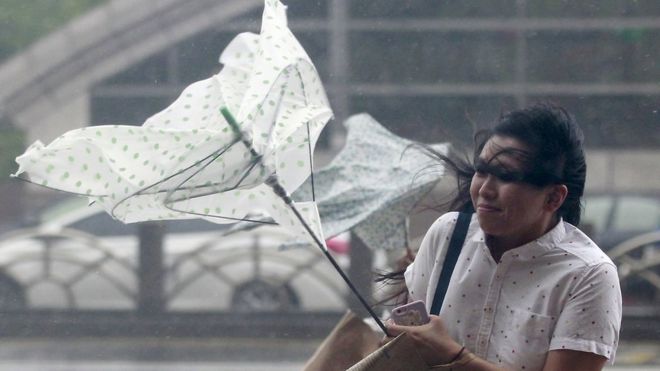
A woman holds onto her umbrella while walking against strong winds caused by Typhoon Dujuan in TaipeiImage copyrightReuters
Image captionStrong winds have already hit the country ahead of Dujuan's arrival

Thousands of people have been evacuated and tens of thousands of troops are on standby ahead of Typhoon Dujuan's arrival in Taiwan.
Taiwan's Central Weather Bureau upgraded Dujuan to a "strong typhoon" on Sunday - also known as "super typhoon" by some weather agencies.
Landfall in Taiwan is expected at 11:00 pm local time (1500 GMT), bringing heavy rain and high winds.
The storm is expected to weaken before reaching mainland China on Tuesday.
Before hitting Taiwan, Dujuan will pass close to Japan's Ishigaki island, where theJapan Meteorological Agency has warned it could cause 13 metre-high waves.

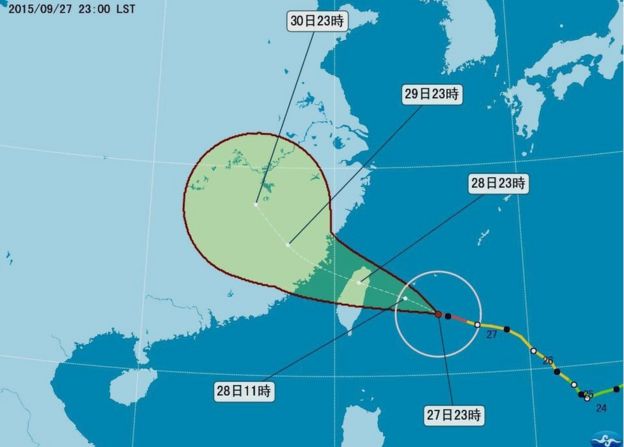
An image made available by Taiwan's Central Weather Bureau shows Dujuan approaching Taiwan's east coast on 27 SeptemberImage copyrightCentral Weather Bureau
Image captionTaiwan's Central Weather Bureau issued a sea and land warning for Dujuan on Sunday, saying it was now a strong typhoon

Around 3,000 people, mostly tourists, were evacuated from Taiwan's Green Island and Orchid Island on Sunday, with around 4,000 more moved from vulnerable areas on Monday.
Some of those were transported from the hot spring town of Wulai, near Taipei. Wulai was badly hit by Typhoon Soudelor in August and the Weather Bureau warned that rubble left over from that could cause more damage this time.
Soudelor, the most powerful storm of the season so far, killed at least eight people in Taiwan and a further 21 in China.
The storm has already disrupted many people's plans for the mid-autumn festival long weekend. Hundreds of flights and many ferry services have been suspended.
US rock band Bon Jovi also cancelled a concert planned for Monday night - their first gig in Taiwan in decades - though they are currently still planning to perform on Tuesday.

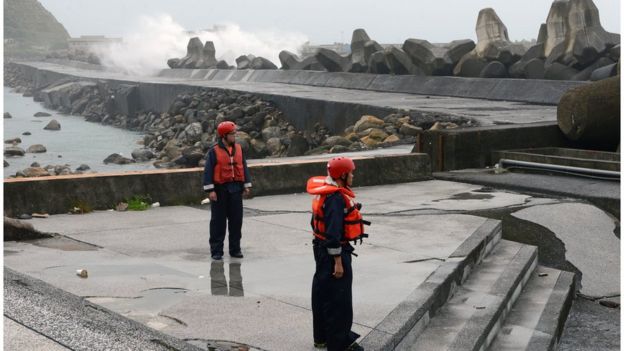
Taiwanese coast guards keep watch on the coastline of Keelungas typhoon Dujuan approachesImage copyrightGetty Images
Image captionThe storm was already causing high waves and many ferry services have been cancelled

Thursday, September 17, 2015

20150918 Ming Pao【智利8級強震】百萬人疏散 海嘯預警遠至日本新西蘭 (14:51)

智利海岸發生8.3級強烈地震,已造成5人死亡、1人失蹤,100萬人疏散。地震後當局發出海嘯警報,部分沿海地區被淹,遠至亞洲日本都在預警範圍內。
智利總統巴切萊特說,死者包括遭屋頂塌下砸死的35歲女子、被落石壓死的20歲女子,以及心臟病發死亡的80多歲老翁。她計劃前往受影響最嚴重的災區。這是智利2010年以來最嚴重的地震。
路透社引述海軍稱,已經有4.5米高海嘯湧向海濱城市科金博。智利政府敦促居民撤離海岸線。
智利外海發生8.3級強震後,不僅美國加州部分地區發布海嘯警示,地震威力大到連距智利9600公里的新西蘭,也警告民眾小心新西蘭部分地區可能出現海嘯。
路透社報道,美國國家海嘯警報(National Tsunami Warning Center)中心向加州部分地區發出海嘯警示,並表示抵達加州部分地區的海浪預計高度將不到0.3米。
美聯社報道,太平洋海嘯警報中心(Pacific Tsunami Warning Center)表示,南太平洋最可能受到波及的地方是法屬玻里尼西亞,可能出現3米高海浪。
新西蘭民防部17日發布海嘯預警說,智利強烈地震引發的海嘯可能波及新西蘭,提醒新西蘭南北兩島東部居民遠離沿海地區,又說如果海嘯真的來襲,可能將在當地時間18日凌晨出現(香港時間17日晚間8時)。
民防部在聲明中表示,智利地震後,新西蘭南北兩島東部可能會出現較大海浪,對河口、海岸、港口等區域影響較大。聲明說,現階段地質評估顯示,新西蘭沿海地區出現海水倒灌可能性不大,但相關情況可能隨時發生變化。
聲明說,預期海嘯將在智利地震後12小時抵達新西蘭東部外島查塔姆群島,13小時後抵達新西蘭北島最東端。強大的海浪預計在新西蘭東部海域持續24小時,最高峰可能維持4至10小時。
民防部表示,部分東部地區的居民應該遠離海灘與海岸線。這些地區包括東角(East Cape)、查塔姆群島(Chatham Islands)、科羅曼德(Coromandel)與班克斯半島(Banks Peninsula)。
(新華社、中央社、路透社、法新社)